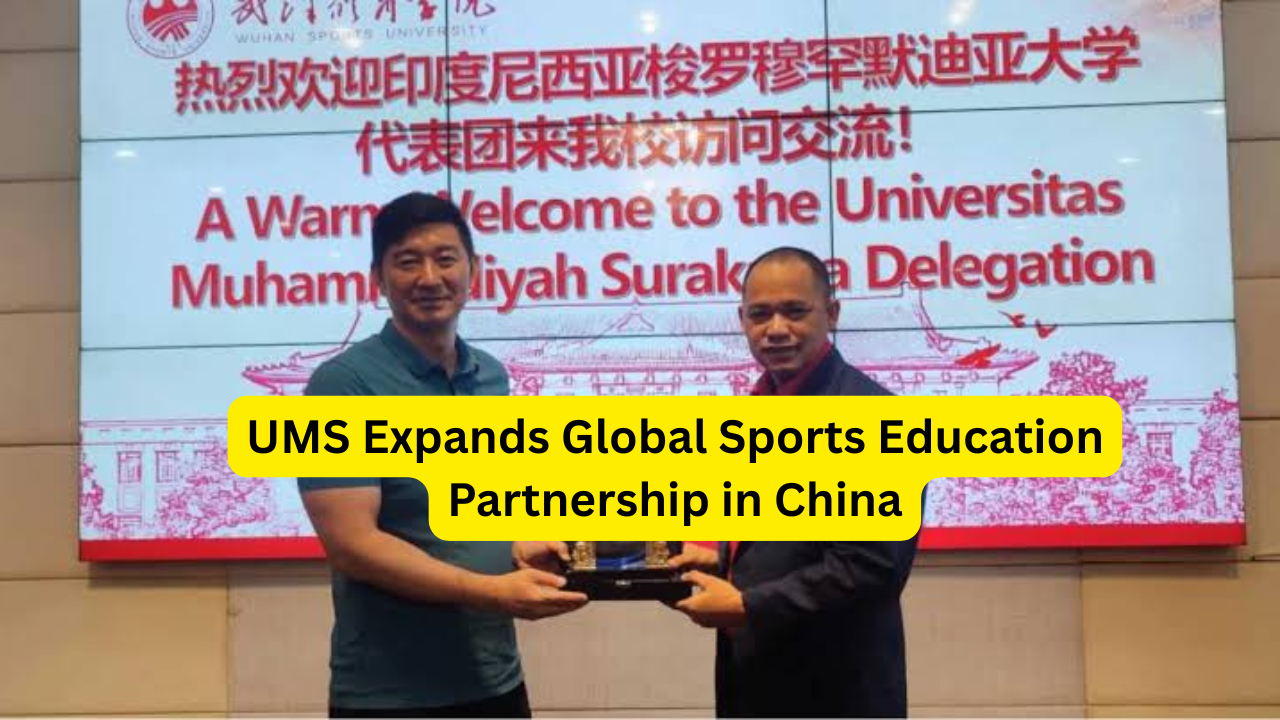
The UMS Physical Education Program has strengthened its international presence by expanding academic collaboration with Wuhan Sports University, opening new opportunities in research, student exchange, and sports science innovation.
UMS Strengthens International Collaboration Through Wuhan Sports University Partnership
The Physical Education (Penjas) Program under the Faculty of Teacher Training and Education at Universitas Muhammadiyah Surakarta (UMS) has taken another significant step toward global academic excellence. Through the implementation of a Memorandum of Understanding (MoU) with Wuhan Sports University (WHSU) in China, the university is reinforcing its commitment to internationalizing higher education while expanding opportunities in education, research, and community service.
The official visit took place from July 16 to July 19, 2026, highlighting UMS’s long-term strategy of building meaningful international partnerships that support the Tri Dharma of Higher Education. Rather than serving as a ceremonial agreement, the collaboration focuses on practical academic initiatives designed to benefit lecturers, students, and researchers from both institutions.
Leadership Delegation Highlights Strong Institutional Commitment
The UMS delegation was led by Dr. Eko Sudarmanto, S.Pd., M.Or., Head of the Physical Education Program. He was accompanied by Agam Akhmad Syaukani, S.Si., M.Ed., Ph.D., who served as the academic liaison and facilitator throughout the visit.
Upon arriving at Wuhan Sports University, the delegation received an official welcome from Dr. Du Geng, representing the Chinese institution. The meeting established a positive foundation for deeper academic engagement and demonstrated both universities’ commitment to developing internationally recognized sports education programs.
Internationalization Goes Beyond Signing an MoU
Although Memorandums of Understanding often mark the beginning of institutional relationships, both universities emphasized implementation rather than symbolism. The discussions focused on translating the agreement into measurable academic outcomes.
Several strategic initiatives emerged from the meetings, including:
• Joint international research projects
• Faculty exchange programs
• Student mobility opportunities
• International seminars and guest lectures
• Publications in reputable international journals
• Curriculum development aligned with global sports science standards
These initiatives reflect the growing importance of cross-border academic collaboration in preparing graduates for an increasingly interconnected world.
UMS Focuses on the Tri Dharma of Higher Education
According to Dr. Eko Sudarmanto, strengthening international cooperation represents a strategic investment in academic quality and institutional competitiveness. He explained that expanding global partnerships enables lecturers and students to participate in broader academic networks while supporting innovation in teaching, research, and community engagement.
He also stressed that internationalization should not be measured by the number of overseas partners alone. Instead, successful collaboration creates an academic ecosystem where ideas, research methods, and cultural perspectives are exchanged to improve educational quality.
Through this partnership, UMS expects its students and faculty members to gain valuable international exposure while contributing meaningful research to the global sports science community.
Wuhan Sports University Shares a Common Vision
Representing Wuhan Sports University, Dr. Du Geng welcomed the collaboration and praised the shared commitment between both institutions to advancing sports education through research and innovation.
He described the implementation of the MoU as the beginning of a long-term strategic relationship that will benefit both universities through collaborative research, academic exchanges, and professional development initiatives.
Such partnerships have become increasingly valuable as universities seek to combine expertise across borders while addressing emerging challenges in sports education, athlete development, and scientific research.
Exploring Advanced Sports Science Facilities
Beyond formal discussions, the UMS delegation participated in a series of academic activities designed to deepen institutional understanding and identify future collaboration opportunities.
The delegation visited several state-of-the-art facilities at Wuhan Sports University, including:
Exercise Physiology Laboratory
Biomechanics Laboratory
High-Performance Sports Fitness Center
Athlete Training Facilities
These visits provided firsthand insights into how advanced sports technology supports elite athlete performance, scientific evaluation, and evidence-based coaching.
Additionally, researchers from both universities exchanged recent findings in sport science, creating opportunities for future collaborative publications and multidisciplinary projects.
Priority Programs Agreed During the Discussions
One of the most productive outcomes of the visit was the identification of several priority programs that both institutions intend to implement over the coming years.
| Collaboration Area | Planned Initiative |
|---|---|
| Research | Joint international research and journal publications |
| Education | International guest lectures and academic seminars |
| Student Development | Student mobility and exchange programs |
| Faculty Development | Lecturer exchange and collaborative teaching |
| Curriculum | Development based on international sports science standards |
| Community Service | Collaborative outreach initiatives supporting the Tri Dharma |
Academic Communication Played a Key Role
Throughout the visit, Agam Akhmad Syaukani ensured effective communication between both institutions. His international academic experience helped facilitate productive discussions that resulted in several shared agreements regarding future implementation strategies.
Effective academic coordination is often essential in international partnerships because it bridges differences in educational systems, research priorities, and institutional practices. Consequently, the successful facilitation of these discussions laid a strong foundation for sustainable collaboration.
Why This Partnership Matters for Sports Education
International cooperation has become an essential element of higher education development. Universities increasingly recognize that complex research challenges require collaboration across countries, disciplines, and cultures.
For UMS, the partnership provides opportunities to improve teaching quality, strengthen international research output, and expose students to global learning environments. Meanwhile, Wuhan Sports University gains another valuable academic partner in Southeast Asia, encouraging broader knowledge exchange and regional cooperation.
Moreover, collaborations like this contribute to the advancement of sport science by combining diverse expertise, expanding research networks, and encouraging innovation in athlete performance, sports technology, and physical education methodologies.
Looking Ahead
The implementation of the MoU between Universitas Muhammadiyah Surakarta and Wuhan Sports University represents more than an institutional agreement. It establishes a practical framework for long-term collaboration focused on education, research excellence, faculty development, and international student engagement.
As both universities move forward with joint research, academic exchanges, and curriculum innovation, the partnership is expected to create lasting benefits for students, educators, and the broader field of sports science. The collaboration also reflects the growing role of international cooperation in shaping the future of higher education and preparing graduates for a globally connected academic and professional landscape.
Frequently Asked Questions
| Question | Answer |
|---|---|
| What is the purpose of the UMS-WHSU partnership? | To strengthen cooperation in education, research, student exchange, and community service. |
| When was the MoU implementation conducted? | From July 16 to July 19, 2026. |
| Who led the UMS delegation? | Dr. Eko Sudarmanto, Head of the Physical Education Program. |
| Which facilities did the delegation visit? | Exercise physiology, biomechanics laboratories, fitness centers, and athlete training facilities. |
| What future programs were agreed upon? | Joint research, faculty exchange, student mobility, international seminars, and curriculum development. |
The information provided in this article is for general informational purposes only. While we strive to keep the content accurate and up to date, readers should verify important details through the official website or the concerned authority before taking any action. This website is not affiliated with any government organization.